
From Quotation to Delivery: What Happens After a Buyer Finds a Supplier?
Finding an international supplier is easier than ever. A few searches can produce dozens of companies offering the product you need. However, finding a supplier and finding the right supplier are two very different things.
For global buyers sourcing chemicals, food ingredients, fertilizers, minerals, and other products, international supplier evaluation should go beyond price. In practice, product quality, production capacity, documentation, export experience, logistics, and long-term reliability can all affect the success of an international order.
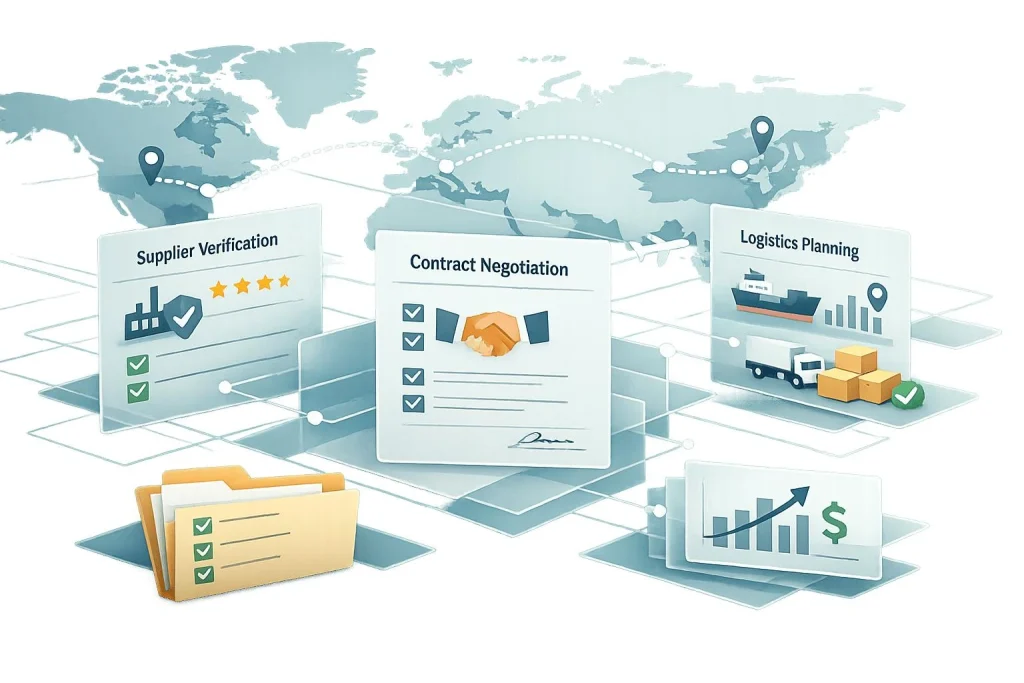
The key question is not simply:
“Who offers the lowest price?”
Instead, buyers should ask:
“Who can reliably deliver the right product, at the right specification, in the right quantity, and under the right commercial conditions?”
This is the principle behind Beyond Price: looking at the complete value and risk of a supply relationship rather than focusing only on the quoted unit price.
What Does International Supplier Evaluation Mean?
International supplier evaluation is the process of checking whether a potential supplier can meet the buyer’s technical, commercial, quality, and logistical requirements.
An attractive quotation does not necessarily mean that a supplier is suitable. For example, limited capacity, inconsistent quality, incomplete documentation, weak export experience, or unclear commercial terms can create problems after an order is placed.
Therefore, supplier evaluation should take place before a major purchase decision.
1. Verify Who You Are Actually Buying From
The first question should be simple:
Who is the actual supplier?
A company may be a:
- Manufacturer
- Distributor
- Trader
- Exporter
- Commercial intermediary
None of these business models is automatically better or worse. Instead, the important point is to understand the supplier’s actual role in the supply chain.
For manufacturers, buyers may need to review production facilities, capacity, quality systems, lead times, and export markets. For traders or distributors, the focus may be on product source, stock availability, traceability, and supply agreements.
As a result, the supplier’s position can directly affect price, availability, lead time, and supply continuity.
2. Check the Product Specification
A supplier should be evaluated against the buyer’s actual specification, not simply the product name.
Two suppliers may offer the same product while providing different grades, concentrations, physical forms, or quality parameters.
Depending on the product, buyers may need to check:
- Chemicals: purity, concentration, physical form, and technical parameters
- Food Ingredients: grade, certifications, shelf life, and quality parameters
- Fertilizers: nutrient composition, grade, origin, and applicable specifications
A reliable supplier should clearly define what is being offered and provide documents that support the quoted specification.
In addition, buyers can explore LinkTPA’s Product Portfolio for an overview of the products available through its supply network.
3. Review Quality and Technical Documents
Documentation is one of the most useful tools in international supplier evaluation.
Depending on the product, buyers may request:
- Certificate of Analysis (COA)
- Technical Data Sheet (TDS)
- Safety Data Sheet (SDS)
- Product Specification
- Certificate of Origin
- Quality or regulatory certificates
- Inspection documents
However, the key question is not simply whether documents are available. The information should also be consistent.
Product specifications, COA, packaging details, and commercial quotations should describe the same product accurately. For technical or regulated products, buyers should review these documents before finalizing the transaction.
For chemical products, buyers can also refer to the Globally Harmonized System of Classification and Labelling of Chemicals (GHS) for information on chemical classification and safety communication.
4. Evaluate Production Capacity and Supply Continuity
A supplier may be able to complete one shipment without having enough capacity for a long-term purchasing program.
For this reason, buyers should consider:
- Monthly production capacity
- Current commitments
- Available stock
- Minimum order quantity
- Lead time
- Seasonal factors
- Ability to increase supply
- Raw material availability
This point becomes especially important for recurring or large-volume purchases.
For example, a supplier capable of delivering 100 MT today may not be able to supply 500 MT every month. Understanding the difference between current availability and sustainable capacity can prevent future procurement problems.
5. Assess International Export Experience
Strong production capability does not automatically mean strong international export capability.
An experienced exporter should understand requirements such as:
- Export documentation
- Packaging requirements
- Customs procedures
- Shipping arrangements
- Commercial terms
- Port operations
In addition, buyers should consider whether the supplier regularly exports and whether it has experience with the destination country or region.
This becomes even more important for complex routes, regulated products, and large-volume shipments.
6. Evaluate Packaging and Logistics
Product quality matters, but the product must also reach its destination in acceptable condition and within the required time.
Depending on the product and shipment method, buyers may need to evaluate:
- Packaging type and size
- Container loading or bulk loading
- Palletization
- Storage requirements
- Loading location
- Port accessibility
- Transportation options
Therefore, international supplier evaluation should consider not only what the supplier produces, but also how effectively it can prepare and move the product for international transportation.
7. Compare Commercial Terms — Not Just Unit Price
After technical and operational requirements have been reviewed, buyers can compare the commercial terms.
At this stage, important factors may include:
- Unit price
- Minimum order quantity
- Payment terms
- Incoterms
- Lead time
- Packaging and loading costs
- Freight arrangements
- Quotation validity
This is where Beyond Price becomes particularly important.
A supplier with a lower FOB price may not provide the lowest landed cost. In contrast, a slightly higher-priced supplier may offer better quality consistency, more reliable delivery, stronger documentation, better payment terms, or greater supply continuity.
Ultimately, the objective is to evaluate total commercial value, not simply the lowest number on the quotation.
8. Check Communication and Responsiveness
Communication can also provide useful insight into a future business relationship.
For example, buyers can consider the following questions:
- Does the supplier understand the inquiry?
- Are technical questions answered clearly?
- Are documents provided promptly?
- Are quotations complete?
- Are changes communicated transparently?
- Is there a clear commercial contact?
International transactions often involve different time zones, technical documents, logistics providers, and several operational stages.
As a result, clear and consistent communication can reduce unnecessary delays and misunderstandings.
9. Look Beyond the First Shipment
Supplier evaluation should not end with one question:
“Can they deliver this order?”
For recurring purchasing requirements, buyers should also ask:
- Can they maintain consistent quality over time?
- Will they be able to support future volumes?
- How consistently can they provide reliable documentation and commercial terms?
- What happens when market conditions change
In other words, the objective is not simply to qualify a company for one transaction. Buyers should determine whether the supplier can become a reliable part of their long-term supply chain.
A Practical International Supplier Evaluation Checklist
Before placing a significant international order, buyers should consider:
| Evaluation Area | Key Question |
|---|---|
| Company | Who is the actual supplier? |
| Product | Does the specification match the requirement? |
| Quality | Can appropriate documentation be provided? |
| Capacity | Can the required quantity be supplied consistently? |
| Export | Does the supplier have international experience? |
| Packaging | Is the product prepared for international transport? |
| Logistics | Can the required delivery route be supported? |
| Commercial Terms | Are price, Incoterms, and payment terms acceptable? |
| Communication | Is the supplier responsive and transparent? |
| Continuity | Can the supplier support future requirements? |
Overall, no single factor should determine the final decision. Supplier qualification should instead be based on the overall risk and value of the relationship.
When Professional Supplier Evaluation Adds Value
For companies purchasing directly from overseas suppliers, evaluating potential sources can require significant time and commercial resources.
The process becomes more complex when buyers compare suppliers from several countries, purchase technical products, manage large volumes, or establish recurring supply programs.
In these situations, professional International Sourcing support can help buyers structure the supplier search and evaluation process more efficiently.
An Export Management Company (EMC) can add value by combining supplier-market knowledge with product understanding, commercial negotiation, and international trade coordination.
The goal is not to add another unnecessary layer between buyer and supplier.
Instead, the goal is to help ensure that the right supplier is selected for the right requirement.
Conclusion
A supplier’s quotation is only the beginning of an international purchasing decision.
Before placing an order, global buyers should evaluate the supplier’s identity, product specification, quality documentation, production capacity, export experience, logistics capability, commercial terms, and long-term reliability.
The strongest supplier is not necessarily the one offering the lowest price.
Rather, it is the supplier that can consistently deliver the right product, at the required quality and quantity, under reliable commercial and logistical conditions.
That is the essence of Beyond Price — looking beyond the quotation to understand the real value and risk behind an international supply relationship.
Need to Qualify a Supplier with Greater Confidence?
Every supplier, product, and market comes with different technical, commercial, and logistical considerations.
Our team can help you assess potential suppliers, verify key information, and develop a practical sourcing approach based on your specific requirements.
Connect with our team to discuss your sourcing needs.