Production Process
The conventional production of fish meal involves a sequence of operations generally including cooking, pressing, drying and grinding. Cooking helps coagulate proteins and release water and oil, while pressing separates the solid and liquid fractions. The solid fraction is subsequently dried and milled to produce fish meal.
Processing conditions are particularly important because excessive heating can adversely affect protein quality and amino-acid availability. Consequently, the visual appearance of the product should not be considered independently from analytical quality and processing history.
Source: FAO — The Production of Fish Meal and Oil: Products – https://www.fao.org/4/X6899E/X6899E11.htm
Raw Material
The nutritional characteristics of fish meal depend substantially on the raw material used. Products can be manufactured from whole fish or from fish-processing materials and by-products. The proportion of bones, heads, frames and other components affects protein, ash, mineral and energy levels.
Source: Feedipedia — https://www.feedipedia.org/node/208
For this reason, when sourcing internationally, the buyer should request information about the fish species, raw-material origin and production process rather than evaluating the product solely by its protein percentage
Nutritional Value
The principal nutritional advantage of fish meal is its combination of high protein concentration and a favorable essential amino-acid profile. Important amino acids include lysine, methionine, threonine, leucine and valine, which contribute to the nutritional value of fish meal in animal and aquaculture feeds.
Fish meal can also provide significant amounts of calcium and phosphorus. However, mineral concentration is closely related to the proportion of bones, heads and frames in the raw material. Higher ash content can therefore be associated with lower protein and energy concentration.
Source: Feedipedia — Fish meal – https://www.feedipedia.org/node/208
Typical Specification
There is no single universal specification for all feed-grade fish meal. Protein, ash, fat, moisture and other parameters can vary according to fish species, raw material, processing method and product grade.
Titan Prime Alliance Inc. (TPA Canada) provides international sourcing and export solutions for Fish meal in different type with 60 – 75 % crude protein , base on the supplier analysis report. Feedipedia reports the following average compositional values on a dry-matter basis:
A : Type A, approximately 67.8% crude protein, 10.3% ether extract and 19.3% ash.
B : Type B ,approximately 70.7% crude protein, 10.0% ether extract and 18.2% ash.
C : Type C, approximately 74.8% crude protein, 9.8% ether extract and 15.2% ash.
These figures are database averages and should not be used as a purchase specification. Actual commercial limits must be agreed with the supplier and confirmed by COA.
Source: Feedipedia — Fish Meal Composition Database– https://www.feedipedia.org/node/208
Why Ash Matters
Ash is an important purchasing parameter because it represents the mineral fraction of the product. Fish meal with a higher proportion of bones, heads or frames can have a higher ash content and consequently a lower concentration of protein and energy.
This is one reason why two fish meals with apparently similar protein levels may still differ in nutritional and commercial value.
Quality Parameters for Purchasing
For international sourcing, the following parameters should normally be evaluated:
- Crude Protein
- Moisture
- Crude Fat / Ether Extract
- Ash
- Salt / Sodium Chloride
- Calcium
- Phosphorus
- Amino Acid Profile, where required
- Digestibility, where required
- Microbiological Quality
- Contaminants / Heavy Metals, according to destination requirements
- Freshness / Oxidation Indicators, where applicable
The exact limits should be defined according to the intended feed application and destination-market requirements rather than applying one generic specification to every fish meal.
Source: Feedipedia — Fish meal – https://www.feedipedia.org/node/208
Appearance
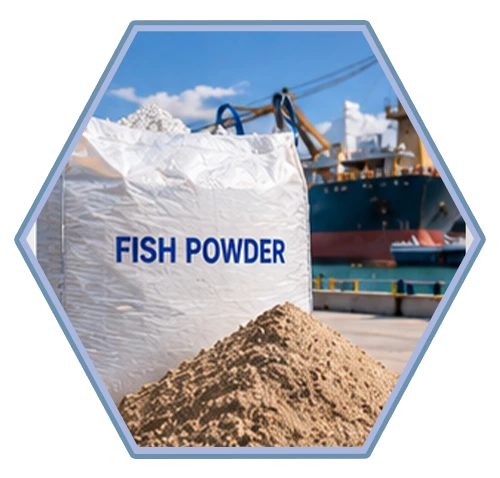
Feed-grade fish meal is generally present by suppliers as a brown to dark-brown powder, but color can vary according to raw material and processing conditions. Color alone should not be used as a quality specification.
A particularly dark product accompanied by an abnormal or scorched odor may warrant investigation because excessive heat during processing can negatively affect nutritional quality.
Source: FAO — The Production of Fish Meal and Oil: Products
https://www.fao.org/4/X6899E/X6899E11.htm
Storage
Fish meal should be stored under conditions that minimize exposure to moisture, excessive heat, contamination and oxidation. Appropriate storage is important for maintaining nutritional quality and preventing deterioration during the supply chain.
Source: FAO — Quality Control in Fish Feed Manufacturing
https://www.fao.org/4/X5738E/x5738e0r.htm
COA & Quality Documentation
For commercial transactions, a Certificate of Analysis (COA) should be requested for the relevant production batch. The COA should correspond to the contractual specification and, depending on the buyer’s requirements, may include protein, moisture, fat, ash, salt, calcium, phosphorus and microbiological parameters.
Additional testing may be required for contaminants, heavy metals or other parameters depending on the destination market and intended feed application.
Source: FAO — Quality Control in Fish Feed Manufacturing
https://www.fao.org/4/X5738E/x5738e0r.htm
Commercial Sourcing Checklist
When requesting offers from suppliers, I recommend that we do not simply ask for “Fish Powder Feed Grade.” The RFQ should identify the actual required grade.
For example:
Product: Fish Meal / Fish Powder – Feed Grade
Protein: Minimum required level
Moisture: Maximum
Ash: Maximum
Fat: Required range / maximum
Salt: Maximum
Calcium: Required range
Phosphorus: Required range
Raw Material: Whole fish / by-product
Fish Species: declared
Origin: declared
Production Process: will be declared
Microbiological Requirements: According to destination
Packaging: As required
COA: Required
Shelf Life: declared
Loading Port: confirmed
Looking for the Right Fish Meal ?
The appropriate fish meal specification depends on the target feed application, required protein level, nutritional parameters, destination market and purchasing requirements. If you are looking for a specific grade or require additional technical information.
Titan Prime Alliance Inc. can assist with product specifications, supplier sourcing, COA review, and commercial supply options. Contact the TPA | Canada team to discuss your requirements and available supply options.