Key Product Advantages
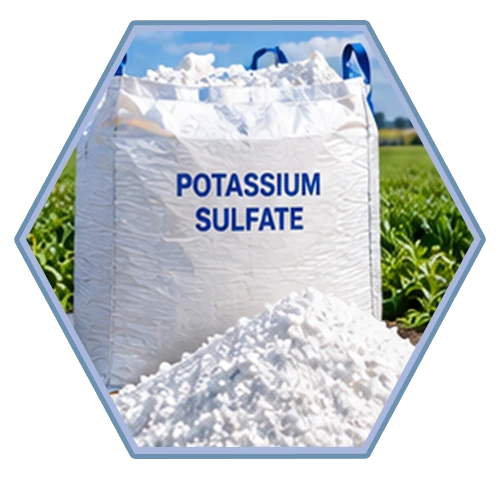
- High potassium content: Typically around 50–52% K₂O in fertilizer grades.
- Sulfur source: Typically provides approximately 17–18% sulfur in sulfate form.
- Low chloride: Suitable for applications where chloride input needs to be minimized.
- Two nutrients in one product: Supplies both potassium and sulfur simultaneously.
- Suitable for specialty crops: Particularly relevant for fruit, vegetables, potatoes, tobacco and other chloride-sensitive crops.
- Water-soluble grades available: Suitable for fertigation and liquid fertilizer production.
- Multiple physical forms: Available depending on grade and supplier requirements.
- Suitable for fertilizer blending: Granular and fine grades can be used in fertilizer manufacturing and blending.
SOP for Fertigation
Water-soluble SOP grades are widely used in fertigation because potassium and sulfate are readily available after dissolution.
High-solubility grades can be used in irrigation systems and liquid fertilizer preparation. K+S, for example, offers a 52% K₂O SOP grade specifically designed for fertigation, while Haifa’s SOP grades are positioned for fertigation and liquid fertilizer production.
For fertigation applications, buyers should pay particular attention to:
- Water solubility
- Insoluble matter
- Chloride and sodium levels
- Particle size
- Compatibility with other fertilizers
- Water quality
- Required concentration and application system
Important: Calcium-containing fertilizers may require special compatibility consideration when preparing concentrated fertilizer solutions; manufacturers’ mixing recommendations should be followed.
Physical Forms & Grades
SOP is commercially available in several forms depending on the application:
Granular SOP
Designed primarily for direct soil application, fertilizer blending and distribution. Granular products generally offer easier handling and more controlled application.
Fine / Crystalline SOP
Suitable for direct application, fertilizer blending and applications requiring smaller particle sizes.
Water-Soluble SOP
Produced for fertigation, irrigation and liquid fertilizer preparation, with emphasis on rapid dissolution and low insoluble content.
The exact particle size, K₂O concentration and chloride specification should be confirmed according to the buyer’s intended application.
Industrial Applications
Beyond agricultural fertilizer, potassium sulfate is also available in industrial and high-purity grades.
Industrial-grade K₂SO₄ can be used as a raw material, accelerator or nutrient salt in specialized manufacturing processes. K+S, for example, supplies potassium sulfate grades at 95%, 99.6% and 99.9% purity, with applications extending beyond conventional fertilizer use.
This means that an SOP sourcing inquiry should clearly distinguish between:
Fertilizer Grade → agricultural applications
Technical / Industrial Grade → industrial manufacturing and specialized applications
Production & Origin
Through its international sourcing network, Titan Prime Alliance Inc. supports buyers in identifying suitable Potassium Sulfate suppliers, reviewing product specifications, and coordinating export requirements.
A significant portion of SOP is produced synthetically, including processes involving potassium chloride and sulfuric acid. Other production routes use naturally occurring potassium-bearing minerals or salt deposits. Yara notes that SOP is primarily produced by reacting MOP with sulfuric acid, while a smaller share comes from natural deposits.
Alternative production technologies are also being developed. For example, K+S has documented cooperation involving the Glaserite process, using potassium chloride together with industrial residues and renewable energy inputs to produce SOP.
Therefore, origin, production route and feedstock can be relevant commercial considerations when evaluating SOP suppliers
Procurement Considerations
When sourcing SOP internationally, price per metric ton alone does not provide a sufficient basis for comparing offers.
Buyers should evaluate:
- K₂O content
- Sulfur content
- Chloride level
- Water solubility
- Particle size
- Moisture
- Physical form
- Packaging
- Origin and production route
- COA and batch consistency
For fertilizer blending or fertigation, the difference between a standard granular grade and a high-solubility grade can be commercially significant even when both products are sold under the same general name of Potassium Sulfate / SOP.
SOP vs. MOP — Key Difference
MOP & SOP are both potassium fertilizers, but they are not interchangeable in every application.
K₂SO₄ supplies potassium together with sulfur and has a low chloride content.
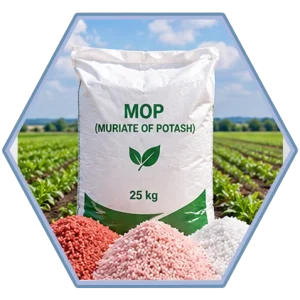
MOP (KCl) supplies a higher concentration of potassium, typically around 60% K₂O, but also introduces a significant amount of chloride.
As a result, MOP is often the more economical potassium source for chloride-tolerant crops, while SOP is generally preferred when chloride sensitivity, sulfur requirements or crop quality considerations are important. FAO specifically identifies potassium sulfate as a better choice for crops sensitive to high chloride levels.
The distinction is therefore not simply “which fertilizer is better?” but rather which potassium source is better suited to the crop, soil, water conditions and commercial objective.
Looking for a reliable supply of Potassium Sulfate (SOP)?
Titan Prime Alliance Inc. (TPA Canada) can assist with supplier identification, product specifications, and international export arrangements.Contact us