
Citric Acid
Citric Acid
Food Grade | Anhydrous & Monohydrate | INS 330
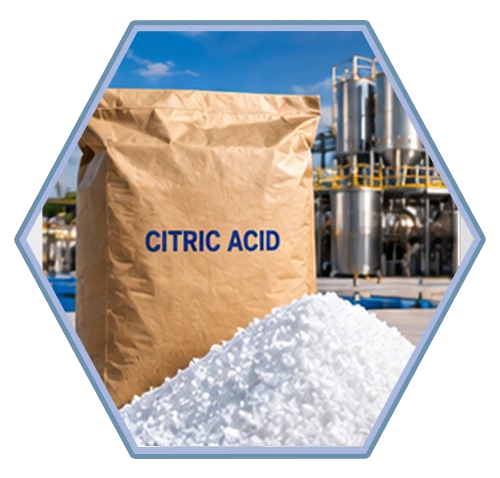
Citric Acid is a widely used organic acid for food, beverage, pharmaceutical, personal care, detergent and industrial applications. It provides controlled acidity and also works as a sequestrant, flavouring agent and antioxidant synergist. Commercial Citric Acid is mainly available in two forms: Anhydrous and Monohydrate.
Its high water solubility and versatile functional properties make Citric Acid a practical raw material for many formulations. The required form, grade, particle size and specification depend on the final application. Source: FAO JECFA Monographs 16 – Citric Acid
Key Technical Information
Product Name: Citric Acid
Chemical Name: 2-Hydroxy-1,2,3-propanetricarboxylic acid
INS No.: 330
CAS No. – Anhydrous: 77-92-9
CAS No. – Monohydrate: 5949-29-1
Molecular Formula – Anhydrous: C₆H₈O₇
Molecular Formula – Monohydrate: C₆H₈O₇·H₂O
Molecular Weight – Anhydrous: 192.13 g/mol
Molecular Weight – Monohydrate: 210.14 g/mol
Physical Form: White or colourless crystalline solid
Main Commercial Forms: Anhydrous / Monohydrate
HS Code: 2918.14 – Citric Acid
UN Number: Generally not assigned as a dangerous-goods UN number for standard transport; always confirm the current supplier SDS and transport classification before shipment.
JECFA identifies Citric Acid as INS 330 and lists separate CAS numbers and molecular formulas for the anhydrous and monohydrate forms.

Global Export

Bulk Availability

Consistent Quality

High Purity
Product Description
Manufacturing
Commercial Citric Acid production mainly relies on microbial fermentation.
Manufacturers typically ferment carbohydrate-based raw materials and then recover and purify the Citric Acid. The process can include filtration, purification, concentration, crystallization and drying.
JECFA recognizes fermentation of carbohydrate solutions or other suitable media using non-toxigenic Aspergillus niger strains or suitable Candida species.For international B2B procurement, buyers should specify the required form, grade, purity, particle size, packaging and destination before requesting a quotation
Modern commercial production therefore differs from the traditional image of extracting Citric Acid directly from citrus fruit. Natural citrus sources contain Citric Acid, but industrial supply depends primarily on controlled production processes. Source: FAO JECFA Monographs 16
3. Commercial Forms
A. Citric Acid Anhydrous ◆
Anhydrous type contains no crystallization water. It has a molecular weight of 192.13 g/mol and a maximum water content of 0.5% under the JECFA specification.
This form can suit formulations where low moisture content matters. Therefore, buyers should consider Anhydrous Citric Acid when moisture control forms part of the product specification. Source: FAO JECFA Monographs 16
B. Citric Acid Monohydrate ◆
Monohydrate type contains one molecule of crystallization water. It has a molecular weight of 210.14 g/mol.
JECFA describes the monohydrate as a white or colourless crystalline solid. It can effloresce in dry air. Its water content is therefore an important specification when comparing this form with Anhydrous Citric Acid. Source: FAO JECFA Monographs 16 –
4. Functional Properties
It offers several functions within a formulation. The most important ones include the following:
A. Acidity Regulation ◆
It provides acidity control in food, beverages and other formulated products. Its acidic character also makes it useful where a controlled pH is required.
B. Flavouring & Sour Taste ◆
It provides a characteristic acidic taste. As a result, manufacturers widely use it in beverages, confectionery, fruit products and other food formulations.
C. Sequestration ◆
It can bind certain metal ions. This property helps control the effects of trace metals in selected food, cleaning and industrial formulations.
D. Antioxidant Synergy ◆
It can support antioxidant systems by complexing certain metal ions that may contribute to oxidation. Therefore, formulators may use it as an antioxidant synergist rather than as a primary antioxidant.
E. Buffering & pH Control ◆
It can work with citrate salts in buffer systems. This makes it useful when a formulation requires controlled acidity or pH adjustment.
6. Technical Specifications
The following values refer to the JECFA specification for Citric Acid. A specific supplier may apply tighter limits. Therefore, buyers should always compare the final offer with the supplier’s current COA and TDS.
General Specification
Appearance: White or colourless, odourless crystalline solid
Assay: 99.5–100.5% on an anhydrous basis
Solubility: Very soluble in water; freely soluble in ethanol; slightly soluble in ether
Sulfated Ash: Maximum 0.05%
Oxalate: Maximum 100 mg/kg
Sulfates: Maximum 150 mg/kg
Lead: Maximum 0.5 mg/kg
Readily Carbonizable Substances: Complies with specification
Water Content
Anhydrous: Maximum 0.5%
Monohydrate: 7.5–8.8%
JECFA specifies an assay of not less than 99.5% and not more than 100.5% on an anhydrous basis. It also sets limits for sulfated ash, oxalate, sulfates and lead. Source: FAO JECFA Monographs 16 – Citric Acid Specification
Commercial Note: The values above represent a recognized reference specification. The actual purchasing specification should follow the buyer’s application, destination-market regulations and approved supplier COA.
7. Food & Beverage Applications
It has a broad role in food and beverage formulations. It can provide acidity, flavour and sequestration functions. Codex identifies Citric Acid as INS 330 and lists it across multiple food categories.
Common applications include:
- Soft drinks , Carbonated beverages , Fruit drinks and juices, Beverage concentrates, Confectionery, Jams and fruit preparations ,Sauces and dressings ,Processed foods, Dairy-based formulations, Selected meat, fish and seafood products
The permitted use level depends on the specific food category and applicable regulations. Therefore, buyers should check the requirements of the destination market before commercial use. Source: Codex GSFA Online – Citric Acid (INS 330)
8. Pharmaceutical Applications
It has several roles in pharmaceutical formulations. Its chemical functionality allows formulators to use it in buffering, effervescent systems, taste-related applications and selected excipient systems.
Citric Acid can also react with carbonate or bicarbonate systems to generate effervescence. This property supports applications such as effervescent tablets and other dosage forms.
The required grade should match the pharmaceutical application’s applicable pharmacopoeial and regulatory requirements. Source: A Multifunctional Pharmaceutical Excipient
9. Detergent & Cleaning Applications
It can support cleaning formulations through its acidity and metal-ion complexing properties.
These properties make it useful in selected products designed to address mineral deposits and hard-water residues. It can also contribute to formulation pH control.
The required specification depends on the cleaning application. Therefore, industrial users should evaluate purity, particle size, solubility and handling requirements before purchase.
10. Personal Care & Cosmetics
Citric Acid can serve as a pH-adjusting and buffering ingredient in personal care formulations. Its chelating properties can also support selected formulation systems.
Typical formulation areas can include:
- Hair-care products , Skin-care products, Bath products, Cosmetic formulations , Personal-care preparations
The appropriate grade depends on the finished product and the regulatory requirements of the target market.
11. Water Treatment & Industrial Applications
Citric Acid can support selected industrial cleaning and water-treatment processes because of its acidic and chelating properties.
It can help remove mineral deposits from equipment and certain process systems. However, the exact treatment method depends on the equipment, deposit type and operating conditions.
For industrial procurement, buyers should therefore define the intended process before selecting the grade and specification.
15. Packaging & Storage
Citric Acid should remain protected from moisture and contamination during storage.
Keep the material in tightly closed packaging and store it in a cool, dry and well-ventilated area. Good moisture control is especially important because Citric Acid is highly soluble in water, while the monohydrate form contains crystallization water.
Storage conditions should always follow the current supplier SDS and product-specific recommendations.
16. Handling & Safety
Citric Acid is widely used in food and pharmaceutical applications. However, concentrated material and airborne dust can cause irritation to the eyes, skin or respiratory tract.
Therefore, industrial users should minimize dust generation and provide suitable ventilation. Appropriate personal protective equipment should also follow the current SDS.
The supplier’s SDS should remain the primary reference for handling, storage, exposure control and emergency procedures.
18. Why Source Citric Acid Through TPA ?
Citric Acid is available from multiple international sources. However, the right supplier depends on more than price.
TPA | Canada evaluates sourcing options according to product requirements, supplier capability, commercial terms and logistics.
We can support buyers with supplier identification, specification review, commercial comparison and export coordination. The objective is simple: find a supply option that fits the buyer’s technical and commercial requirements.
If you are looking for Citric Acid, share your required form, grade, quantity, destination and delivery terms with our team.
Need a quotation or sourcing option for Citric Acid? Contact TPA | Canada.
Product details

Documents & Resources
Request a Quote
Fill in the form below and our team will get back to you with the best offer.
Why Choose TPA?

Flexible Packaging & Private Labeling Solutions

Export Documentation Support

Fast and Reliable Global Shipments

Technical & Commercial Assistance
Partner with TPA for your chemical needs.
Frequently Asked Questions
What is the difference between Citric Acid Anhydrous and Monohydrate?
The main difference is their water content. Anhydrous Citric Acid contains no crystallization water and has a maximum water content of 0.5% under the JECFA specification. Monohydrate contains one molecule of crystallization water and has a specified water content of 7.5–8.8%.
Is Citric Acid the same as INS 330?
Yes. Citric Acid carries the Codex INS number 330. Codex and JECFA recognize it as a food additive with functions that include acidity regulation, sequestration and flavouring.
Can Citric Acid be used in beverages?
Yes. Citric Acid is widely used in beverage formulations for acidity and flavour. Codex GSFA includes Citric Acid among the additives used in several food categories. However, the permitted conditions depend on the specific food category and applicable market regulations.
Which Citric Acid form should I choose for my application?
The answer depends on the formulation. Anhydrous Citric Acid may suit applications where lower moisture is important. Monohydrate may suit applications where its standard commercial form and crystallization-water content fit the process. Buyers should confirm the formulation requirement before selecting the form.
Is Citric Acid used outside the food industry?
Yes. Citric Acid also serves pharmaceutical, personal care, detergent, cleaning and selected industrial applications. Its acidity and metal-ion complexing properties make it useful in different formulation and processing systems.
What information should I provide when requesting a Citric Acid quotation?
Provide the grade, form, quantity, particle size, packaging preference, destination and required Incoterm. If you also provide the intended application, TPA | Canada can better match the requirement with an appropriate supplier and specification.
Technical Resources
Check out specialized articles, guides, and expert opinions about this product and its uses.


Related Products