
Aluminum Sulfate – Alum
Product Overview
Aluminum Sulfate, also known as Aluminium Sulphate or Alum, is an inorganic aluminum salt widely used as a coagulant in water and wastewater treatment and as a process chemical in industries such as paper manufacturing.
It is commercially available in both solid and liquid forms, with specifications varying according to the intended application, aluminum oxide content, iron level, insoluble matter and other impurity limits.
In water treatment, Aluminum Sulfate works primarily through hydrolysis and the formation of aluminum hydroxide species that promote coagulation and flocculation, helping suspended particles and other impurities aggregate and separate from water. Source: PubChem – Aluminum Sulfate | Kiki’s Industrial Chemicals – Aluminum Sulfate
Chemical & Technical Identity
- Product Name: Aluminum Sulfate
- Alternative Name: Aluminium Sulphate
- Common Name: Alum
- Chemical Formula: Al₂(SO₄)₃
- CAS No.: 10043-01-3
- EINECS No.: 233-135-0
- Molecular Weight: 342.2 g/mol for anhydrous Al₂(SO₄)₃
- HS Code: 2833.22 — Sulphates of aluminium
- Physical Forms: Solid / Liquid
- Typical Solid Forms: Flakes, Granules, Powder or Lumps
- Typical Hydrated Form: Al₂(SO₄)₃·18H₂O
Aluminum Sulfate occurs commercially in hydrated forms, and its physical and commercial specifications depend on the manufacturing process and intended application. Source: PubChem – Aluminum Sulfate | WCO HS Code 283322
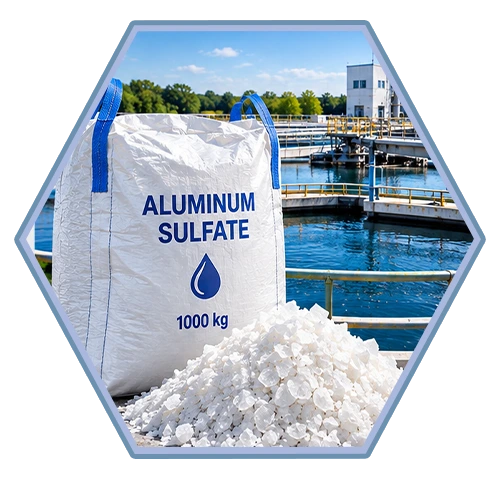

Global Export

Bulk Availability

Consistent Quality

High Purity
Product Description
Product Forms
A.Solid Aluminum Sulfate
Solid Aluminum Sulfate is commonly supplied as:
- Flakes
- Granules
- Powder
- Lumps / Kibbled material
The appearance can range from white or off-white to grayish or slightly colored depending particularly on iron content and grade.
For industrial water-treatment grades, Al₂O₃ content, iron content, water-insoluble matter and particle size are among the principal purchasing parameters.
B.Liquid Aluminum Sulfate
Liquid Aluminum Sulfate is supplied as an aqueous solution and is commonly used where direct dosing into water-treatment systems is preferred.
Liquid grades can offer operational advantages by eliminating the need for dissolving solid material before dosing. Commercial specifications typically define the concentration in terms of Al₂O₃, together with insoluble matter, iron and pH.
Typical Technical Specifications
Note: Specifications can vary by manufacturer, grade, application and applicable national standard. The following represents typical commercial parameters rather than a single universal specification.
Solid — Water Treatment Grade
- Al₂O₃: typically ≥ 15.5–17.0%
- Iron (Fe): typically ≤ 0.5–0.7% for low-iron grades
- Water Insoluble Matter: typically ≤ 0.10–0.20%
- pH (1% aqueous solution): ≥ 3.0
- Appearance: White, off-white, grayish flakes, granules or powder
- Particle Size: According to customer requirement
- Moisture / Water Content: According to applicable grade and standard
Non-ferric / iron-free grades can have substantially lower iron specifications, with some commercial specifications targeting Fe levels around 0.005% or lower.
Source: Shandong Sanfeng – Aluminum Sulfate Water Treatment Standard | Qingdao Sinosalt – Aluminum Sulfate
Liquid — Water Treatment Grade
Typical commercial specifications may include:
- Al₂O₃: approximately 7.8–8.0% or higher, depending on grade
- Iron (Fe): typically ≤ 0.25%
- Water Insoluble Matter: typically ≤ 0.15–0.20%
- pH: ≥ 3.0
- Appearance: Clear to slightly colored aqueous solution
- Concentration: According to customer dosing and handling requirements
Drinking-water specifications can require significantly more detailed limits for contaminants and trace elements, so the required standard should be confirmed before supply.
Key Quality Parameters
For commercial sourcing, the most important parameters are generally:
1. Al₂O₃ Content
Al₂O₃ content is one of the primary commercial indicators of Aluminum Sulfate concentration and grade.
Water-treatment specifications commonly reference values around 15.5–17% Al₂O₃ for solid material, while liquid products are generally specified at lower concentration levels.
2. Iron Content
Iron content is particularly important where the final application requires a cleaner or lighter-colored product.
Two broad commercial categories are often encountered:
- Low-Ferric / Low-Iron Aluminum Sulfate
- Non-Ferric / Iron-Free Aluminum Sulfate
Non-ferric grades can be specified at very low Fe levels compared with conventional low-iron grades.
3. Water Insoluble Matter
Low insoluble content supports efficient dissolution and reduces undissolved residue during water-treatment applications.
Commercial water-treatment specifications commonly set limits around 0.1–0.2%, although the actual requirement depends on the applicable standard and customer specification.
4. pH
Aluminum Sulfate solutions are acidic. Industrial specifications commonly specify a minimum pH around 3.0 for a 1% aqueous solution.
5. Particle Size
For solid products, particle size can be customized according to handling and dosing equipment.
Flakes, kibbled material, granules and powder are all commercially available.
Packaging
Depending on product form, grade and destination market, Aluminum Sulfate may be supplied in:
- 25 kg bags
- 50 kg bags
- 500 kg–1,000 kg Jumbo Bags
- Bulk containers
- Liquid bulk / tanker delivery
For solid material, moisture-resistant packaging is important because Aluminum Sulfate can absorb moisture and may cake during prolonged exposure to humid conditions.
Final packaging should be confirmed according to:
- Destination
- Shipping method
- Storage conditions
- Customer handling system
- Solid particle size
- Required shelf-life / quality-control conditions
Handling & Storage
Aluminum Sulfate should be stored in a dry, cool and well-ventilated area, protected from moisture and incompatible materials.
For solid grades:
- Keep packaging tightly closed.
- Protect from humidity and direct water exposure.
- Avoid prolonged exposure to atmospheric moisture.
- Store on a suitable surface away from potential contamination.
- Prevent dust generation during handling.
- Inspect material for caking or moisture ingress before use.
Dust can irritate the eyes, skin and respiratory tract, while concentrated or laboratory-grade materials may carry stronger corrosive classifications. Appropriate PPE should therefore be selected according to the product’s SDS and concentration.
Source: PubChem – Aluminum Sulfate | Sigma-Aldrich – Aluminum Sulfate SDS
Transportation & Export Considerations
The transport classification of Aluminum Sulfate can depend on the specific product formulation, concentration, applicable transport regulations and SDS.
Some SDS classifications for Aluminum Sulfate products identify:
- UN Number: UN 3077
- Proper Shipping Name: Environmentally Hazardous Substance, Solid, N.O.S.
- Transport Class: 9
- Packing Group: III
However, UN 3077 should not using as a universal classification for every Aluminum Sulfate product. The final transport status must be confirmed from the supplier’s current SDS and the applicable ADR/IMDG/IATA requirements before shipment.
For international sourcing, the commercial HS heading is:
HS Code: 283322 — Sulphates; of aluminium
National tariff schedules may extend this six-digit code into additional digits
Grades Available
Aluminum Sulfate can be commercially offered in several grades according to application.
Low-Ferric / Low-Iron Grade
Designed for general industrial and water-treatment applications where iron content must be controlled but an ultra-low iron specification is not required.
Non-Ferric / Iron-Free Grade
Designed for applications requiring very low iron content. Typical commercial specifications can require Fe around 0.005% or lower.
Water Treatment Grade
Optimized for coagulation and flocculation applications, with specifications focused on Al₂O₃ concentration, insoluble matter, iron and contaminant limits.
Industrial Grade
Used for industrial processes where the exact purity requirements depend on the application.
Important: Grade selection should be based on the customer’s process and required specification rather than simply the product name.
Commercial Supply Formats
Solid Aluminum Sulfate
- Flakes
- Granules
- Powder
- Kibbled / Lumps
Liquid Aluminum Sulfate
- Standard aqueous solution
- Application-specific concentration
The preferred form depends on the customer’s dosing equipment, storage capacity, logistics and required concentration.
Product Advantages
- Established inorganic coagulant for water treatment
- Suitable for municipal and industrial applications
- Available in solid and liquid forms
- Available in low-iron and non-ferric grades
- Flexible particle-size options for solid products
- Suitable for large-scale industrial supply
- Established global trade product with standardized HS classification
Sourcing & Purchasing Considerations
When sourcing Aluminum Sulfate, the following points should be confirmed before quotation:
- Solid or liquid form
- Required Al₂O₃ content
- Low-ferric or non-ferric grade
- Maximum Fe content
- Water-insoluble matter limit
- Required particle size
- Application — drinking water, wastewater, paper or industrial
- Required regulatory standard
- Packaging
- Monthly / annual quantity
- Destination port
- Required documentation and COA parameters
For potable-water projects, the specification finalize around the applicable drinking-water standard rather than using a generic industrial Aluminum Sulfate specification.
Looking to source Aluminum Sulfate for your water treatment or industrial application?
Contact our team to discuss your required grade, specification, packaging and destination. If you need a technical specification, COA review or sourcing support, our team can help identify the appropriate supply option for your project.
Product details

Documents & Resources
Request a Quote
Fill in the form below and our team will get back to you with the best offer.
Why Choose TPA?

Flexible Packaging & Private Labeling Solutions

Export Documentation Support

Fast and Reliable Global Shipments

Technical & Commercial Assistance
Partner with TPA for your chemical needs.
Frequently Asked Questions
What is Aluminum Sulfate mainly used for?
Aluminum Sulfate is mainly used as a coagulant in municipal and industrial water treatment. It is also used in wastewater treatment and paper manufacturing, among other industrial applications
What is the difference between Low-Ferric and Non-Ferric Aluminum Sulfate?
The main difference is the allowable iron content. Low-ferric grades permit a higher level of iron, while non-ferric or iron-free grades are manufactured to much tighter iron specifications and are selected where low iron contamination is important.
Is Aluminum Sulfate available in both solid and liquid form?
Yes. Solid products are commonly supplied as flakes, granules, powder or lumps, while liquid Aluminum Sulfate is supplied as an aqueous solution. The appropriate form depends on the customer's dosing system, concentration requirements and logistics.
Does a higher Al₂O₃ percentage always mean better Aluminum Sulfate?
Not necessarily. Al₂O₃ concentration is an important commercial parameter, but treatment performance also depends on iron, insoluble matter, impurities, raw-water chemistry and the actual treatment process. For water treatment, the correct grade should be selected according to the complete specification and application
Can the same Aluminum Sulfate grade be used for drinking water and industrial wastewater ?
Not automatically. Drinking-water applications can require stricter limits for contaminants such as arsenic and lead and may require compliance with a specific potable-water standard. An industrial-grade product should not be assumed to meet drinking-water requirements without the appropriate certification and analytical documentation
How should Aluminum Sulfate be stored?
Solid Aluminum Sulfate should be kept sealed and protected from moisture in a dry storage area. Moisture exposure can cause caking and affect handling. The exact storage and safety requirements should always follow the supplier's current SDS
Technical Resources
Check out specialized articles, guides, and expert opinions about this product and its uses.

Related Products