linktpa

Caustic Soda Flakes (Sodium Hydroxide)

Reliable Quality & Global Supply

Caustic Soda Flakes

Caustic Soda Flakes, also known as Sodium Hydroxide, Caustic Soda, Lye, Soda Lye, or White Caustic, are a highly alkaline inorganic chemical with the formula NaOH. The product is supplied in solid flake form and is widely used as a strong alkali, neutralizing agent and chemical processing raw material across a broad range of industries. Sodium Hydroxide is also commercially available in other forms, including Prills/Pearls and Liquid Caustic Soda Solution, depending on the application and handling requirements.
Source: PubChem 

Technical Specifications

CAS No.: 1310-73-2
Chemical Formula: NaOH
Physical Form: White / Off-White Flakes
Molecular Weight: 40.00 g/mol
HS Code: 2815.11
UN Number: UN 1823
Dangerous Goods Class: Class 8 – Corrosive
Packing Group: II
Main Forms: Flakes / Prills or Pearls / Liquid Solution

(Source: Pub Chem & UK Tariff Reference )

Forms & Grades

Caustic Soda is available in Flakes, Prills/Pearls and Liquid Solution. Solid forms are suitable for applications requiring concentrated dry material, while liquid caustic soda is commonly used where direct dosing into industrial processes is preferred. Depending on the intended application, Industrial Grade and Food Grade specifications can be supplied, with purity and impurity limits determined according to the relevant technical and regulatory requirements.

Global Export​

Bulk Availability

Bulk Availability

Consistent Quality

Consistent Quality​

High Purity​

Product Description

Production Method

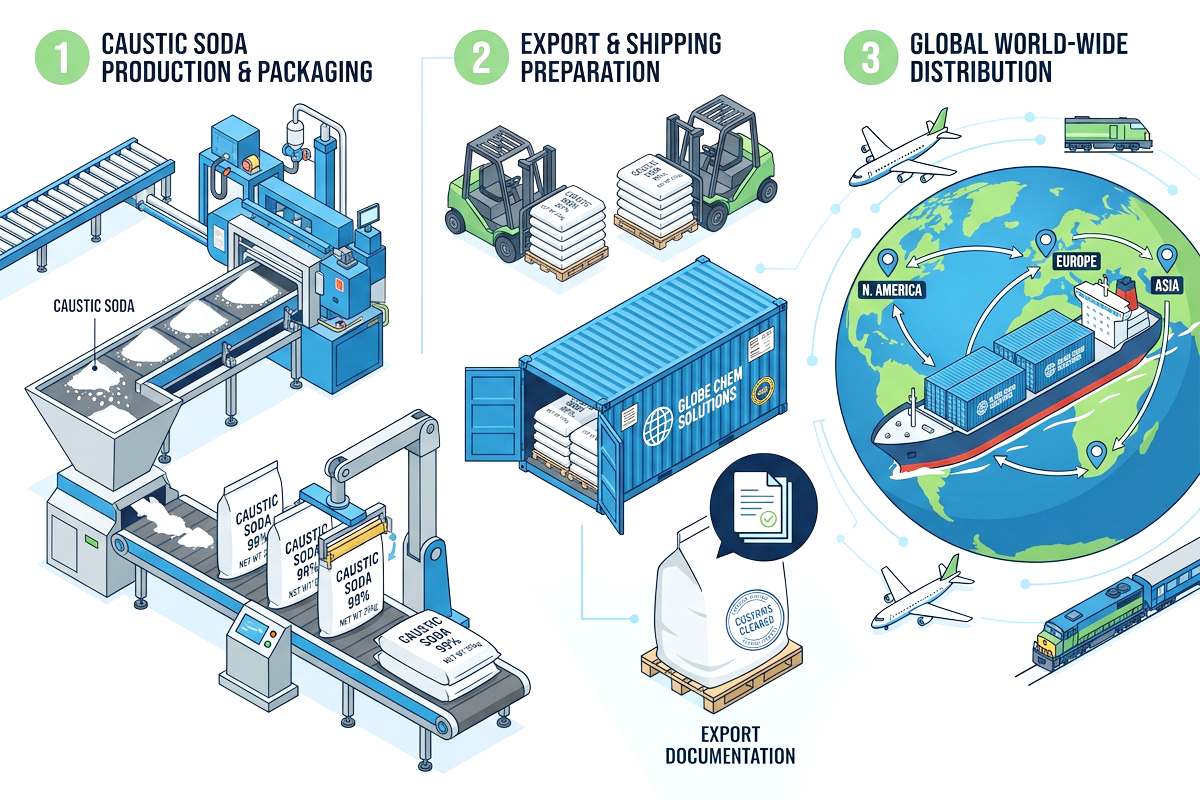
Commercial Sodium Hydroxide is primarily produced through the chlor-alkali process, in which purified sodium chloride brine is electrolyzed to produce sodium hydroxide together with chlorine and hydrogen. The resulting caustic solution is concentrated and can be further evaporated to produce solid Sodium Hydroxide in flake or other dry forms. Modern production commonly uses membrane-cell technology, while production technology and purification can influence the final impurity profile and grade.
Source: U.S. EPA — Sodium Hydroxide Supply Chain Profile


Food Grade

Food Grade Sodium Hydroxide is used in specific food-processing applications as a pH control agent and processing aid. Approved uses can include selected processing, washing or surface-treatment operations, with the applicable requirements depending on the destination market and intended use. In the United States, Sodium Hydroxide is listed under relevant FDA food regulations and is affirmed as GRAS when used in accordance with good manufacturing practice.
Source: U.S. FDA 

Storage & Shelf Life

Caustic Soda Flakes are hygroscopic and should be kept in tightly closed, moisture-resistant packaging in a cool, dry and well-ventilated area. Exposure to moisture and atmospheric carbon dioxide can affect product quality. The product should also be kept away from water, acids and incompatible materials. Shelf life depends on packaging and storage conditions and should be confirmed against the manufacturer’s specification for each shipment.
Source: PubChem 

Handling, Transportation & Shipment

Transportation & Dangerous Goods

Caustic Soda Flakes are classified as a corrosive dangerous good: UN 1823, Sodium Hydroxide, Solid, Class 8, Packing Group II. Appropriate dangerous-goods procedures, packaging and documentation should therefore be followed for international transportation.
Source: PubChem

Packaging & Shipment

The product should be supplied in moisture-resistant export packaging suitable for corrosive solid chemicals and containerized transportation. Packaging configuration can be selected according to shipment quantity, destination, handling requirements and applicable dangerous-goods regulations.

Buyer Information

For international procurement, buyers should confirm the required grade, NaOH purity, impurity limits, packaging, quantity, destination, applicable SDS/TDS documentation and required transport documents before order confirmation.

Need more information about specifications, documentation or sourcing requirements?  Feel free to contact our B2B sourcing specialists for assistance and identifying suitable supply options

 

Product details

Documents & Resources

Request a Quote

Fill in the form below and our team will get back to you with the best offer.

Please enable JavaScript in your browser to complete this form.

Why Choose TPA?

Reliable Multi-Source Supply from Asia & the Middle East

Flexible Packaging & Private Labeling Solutions

Export Documentation Support

Fast and Reliable Global Shipments

Technical & Commercial Assistance

Partner with TPA for your chemical needs.

Frequently Asked Questions

What documents are normally available for Caustic Soda Flakes?

Depending on the grade and shipment requirements, documentation may include a Certificate of Analysis (COA), Safety Data Sheet (SDS), Technical Data Sheet (TDS), Certificate of Origin and relevant dangerous-goods transportation documentation. Additional documents can be provided according to destination-market and customer requirements.

What is the difference between Caustic Soda Flakes and Liquid Caustic Soda?

Both are Sodium Hydroxide, but they differ in physical form and concentration. Flakes are a concentrated solid product that offers advantages in storage and transportation, while liquid caustic soda is supplied as an aqueous solution and can be directly dosed into compatible industrial processes. The appropriate form depends on the customer's process and handling facilities.

What is the shelf life of Caustic Soda Flakes?

The shelf life depends on the product grade, packaging and storage conditions. When kept in properly sealed, moisture-resistant packaging and protected from humidity and contamination, Caustic Soda Flakes can maintain their quality for an extended period. The manufacturer's specified shelf life should be confirmed for each shipment.

Is Food Grade Caustic Soda available?

Yes. Food Grade Sodium Hydroxide is available for specific food-processing applications where the required purity and regulatory specifications are met. It is used primarily as a pH control agent and processing aid in approved applications.

Related Products

×